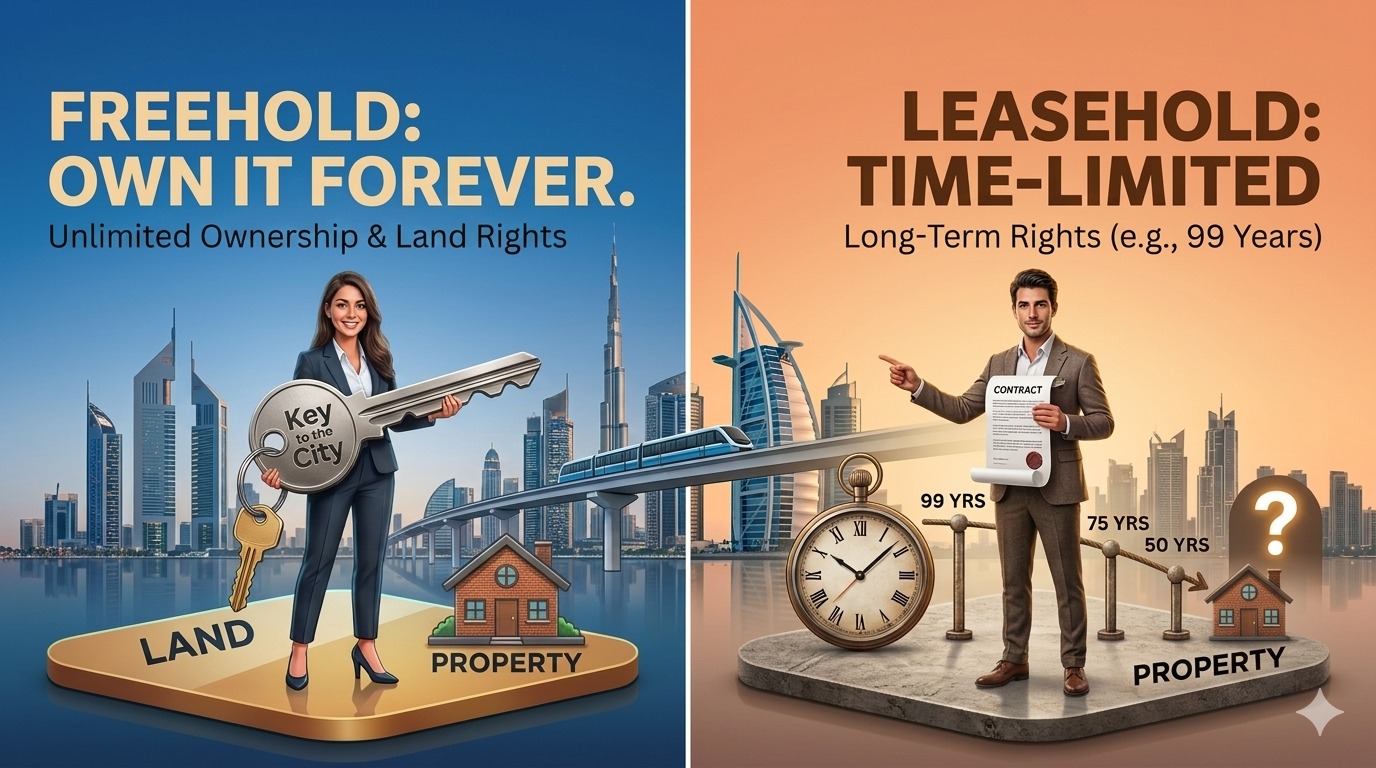
Two clients, same week. Both looking at one-bedroom apartments with almost identical sea views — one in JBR, one a short drive away in Jumeirah. The JBR unit was priced noticeably higher. My Jumeirah client asked me straight: "Why am I paying less for basically the same view?" The answer had nothing to do with the building, the finish, or the beach. It had to do with a word that barely comes up until it's too late to matter: leasehold.
Freehold and leasehold get mentioned constantly in Dubai property conversations, usually as a quick footnote. But the difference changes what you actually own, whether you can mortgage it, what it does to resale, and — for a lot of readers here — whether it counts toward a Golden Visa at all. This is the full picture, not the footnote version.
Freehold, In Plain Terms
Freehold means you own the property and the land it sits on, outright, with no time limit. It's registered in your name at the Dubai Land Department (DLD), and you can sell it, will it, rent it out, or hold it forever. This is what most people picture when they think of "owning" property, and in Dubai it has been open to buyers of any nationality since the government designated specific freehold zones in the early 2000s, formalized under Law No. 7 of 2006.
There are now more than 60 designated freehold areas, covering roughly 40% of the developed city. Dubai Marina, Downtown Dubai, Palm Jumeirah, Business Bay, Dubai Hills Estate, Dubai Creek Harbour, JVC, Arabian Ranches, DIFC and Emaar Beachfront are among the best known — but freehold status is decided at the plot level, not the neighborhood level. Two buildings on the same road can carry different statuses, so a name on a list isn't proof; the specific title has to be checked.
Leasehold, Usufruct and Musataha — The Other Three Words You'll Hear
Outside freehold zones, non-GCC foreigners generally can't hold full title. What's available instead falls into a few legal categories that get used almost interchangeably in marketing material, but aren't the same thing:
- Leasehold (up to 99 years). You hold the right to occupy, use, rent out, sell, or pass on the property for a fixed term — commonly 30, 50, or up to 99 years, depending on the specific development. The land itself stays owned by the original owner, usually the Dubai government or a UAE national. When the term ends, the right reverts to the landowner unless it's renewed — and renewal is not automatic; it can mean renegotiating terms from scratch.
- Usufruct. Similar to leasehold — the right to use and profit from a property for a fixed term, up to 99 years, without owning the land. The main legal distinction from leasehold is that a usufruct holder generally can't make structural alterations to the property, where a long leaseholder may have more flexibility depending on the contract.
- Musataha (up to 50 years). A build-and-hold right — you're granted land to construct or plant on, and you own the structure itself for the term. Less common for a typical apartment buyer, more relevant to developers and commercial projects.
For a standard residential buyer, the practical one to know is leasehold. Just don't assume a "99-year lease" advertised on one project means every leasehold listing runs the same length — some run 30 or 50 years, and that gap matters a lot for resale value later in the term.
Where You Can Buy What
Roughly speaking, Dubai splits into three tiers:
- Freehold zones — any nationality can buy full ownership. This is the majority of what gets marketed to international buyers: Marina, Downtown, the Palm, Business Bay, Hills Estate, Creek Harbour, and dozens more.
- Non-freehold areas — older, more established parts of the city such as Deira, Bur Dubai, Al Qusais, Al Satwa, and parts of Jumeirah and Al Barsha. Full freehold ownership here is reserved for UAE and GCC nationals. Foreigners from outside the GCC can often still buy a long-term leasehold or usufruct interest on specific properties in these areas, but not full title — and terms vary property to property, so this needs checking case by case, not assumed from the area's reputation.
- GCC nationals sit in a category of their own: under UAE law they can hold freehold title anywhere in Dubai, not just the designated foreign-freehold zones, plus usufruct, musataha and long leases elsewhere. If you're a GCC national reading this, the freehold-zone restriction that applies to other foreign buyers doesn't apply to you the same way.
That JBR-versus-Jumeirah price gap my client noticed is exactly this split in action: JBR is freehold, so he'd have owned it outright. The Jumeirah unit he was comparing it to was on a fixed-term lease — same coastline, structurally different asset.
The Differences That Actually Change Your Decision
Financing
Mainstream UAE banks lend more readily against freehold title — it's the collateral they're most set up to assess and recover if a loan defaults. Leasehold and usufruct properties can be mortgaged too, but banks look hard at how many years are left on the term before approving a long mortgage; a property with 40 or more years remaining tends to qualify comfortably, while a shorter remaining term can mean a smaller loan, a shorter repayment period, or a flat decline from some lenders. If you're financing a leasehold purchase, ask your bank about the remaining-term threshold before you commit to a unit, not after.
The Golden Visa Link
This one surprises people. Only freehold property counts toward the AED 2 million Golden Visa property threshold. A leasehold or usufruct property, no matter how high its price, does not qualify you for residency through the property route. If a Golden Visa is part of why you're buying, freehold status isn't optional — it's the whole mechanism.
Resale and Buyer Pool
Freehold properties can be bought by anyone — nationals, GCC citizens, and foreigners of any nationality — which keeps the buyer pool wide. Leasehold properties can only be resold to buyers eligible for that same leasehold or usufruct interest, and as the remaining term shortens, that pool tends to narrow further; a 99-year lease with 90 years left reads very differently to a buyer than one with 20 years left, even if the building is identical. This is a structural fact of any leasehold asset, not a Dubai-specific quirk — it's the same logic that applies to leasehold property in London or Hong Kong.
What Happens When the Term Runs Out
At the end of a lease or usufruct term, the right to the property reverts to the landowner. Many agreements include a path to renew, but renewal isn't automatic and can mean renegotiating the terms — including price — from scratch. If you're buying a leasehold property as a long-term hold, ask exactly how many years are left on the current term today, not how many years the original lease was issued for.
Passing It On
Both freehold and leasehold/usufruct interests can be passed to your heirs — a leasehold right doesn't just evaporate if you pass away mid-term, it transfers for the remainder of the term. Freehold gives your estate a permanent asset; a leasehold interest gives your estate whatever years are left on the clock. If estate planning is part of your thinking, that distinction is worth putting in front of whoever is drafting your will.
How to Check Before You Buy
- Ask for the property's DLD title status directly — "freehold" or "leasehold," in writing — not the area's general reputation.
- If it's leasehold or usufruct, get the exact remaining term in years, not the original term length.
- If you're financing, confirm with your bank whether they'll lend against this specific title type and term length before you commit.
- If a Golden Visa is part of the plan, confirm freehold status is what's actually being registered — not assumed from the price alone.
- If in doubt, verify directly with the Dubai Land Department rather than relying on a listing or an agent's description — the Dubai REST app (DLD's own platform, free on iOS and Android) has an instant Title Deed Verification service under "Services" that confirms tenure type and details in minutes.
Neither structure is automatically the better buy — a leasehold unit with 90-plus years remaining, priced accordingly lower, can be a perfectly reasonable decision for the right buyer. What matters is knowing which one you're actually signing up for, and pricing that difference into your decision yourself, instead of finding out later what the word on page one of the contract actually meant.
Have a question about this? Message me directly — no forms, no gatekeeping.
Chat on WhatsAppDisclaimer
This article explains how freehold, leasehold, usufruct and musataha ownership generally work in Dubai, based on Law No. 7 of 2006 and reputable industry and legal reporting at the time of writing. Freehold designation is decided at the individual plot level, and leasehold or usufruct terms vary by development, so nothing here should be treated as confirmation of a specific property's status. Before signing a contract, transferring funds, or applying for a mortgage or Golden Visa on this basis, verify the exact title type and remaining term directly with the Dubai Land Department, your bank, or a licensed conveyancer. Nothing here is legal or financial advice.